Solving the Mystery of “Why Did It Break?”
When a component fails in service, the cost can be measured in downtime, warranty claims, and reputation. Failure analysis is the forensic process of determining the root cause of that failure. It is not just about identifying how a part failed, but why it failed-and what can be done to prevent recurrence.
What Failure & Defect Analysis Can Reveal
Investigations commonly uncover issues such as:
- Wrong material or incorrect alloy grade
- Heat treat problems or microstructural nonconformance
- Fatigue cracking, overload, or brittle fracture
- Corrosion mechanisms (including environmental or chemical contributors)
- Manufacturing defects (porosity, laps, seams, inclusions)
- Coating/plating problems and surface condition concerns
- Welding discontinuities and HAZ-related cracking
APL is uniquely qualified to investigate failures in metallic components, from bolts and brackets to heavy industrial machinery. We combine all our laboratory disciplines-chemical, mechanical, and metallographic-to build a complete picture of the failure event.
How Investigations Are Performed
While each case is unique, many follow a consistent path:
- Background Review: Service conditions, loads, environment, processing history, and timeline.
- Visual & Macroscopic Examination: We document fracture surfaces, crack origins, wear patterns, and surface conditions to establish the mode of failure.
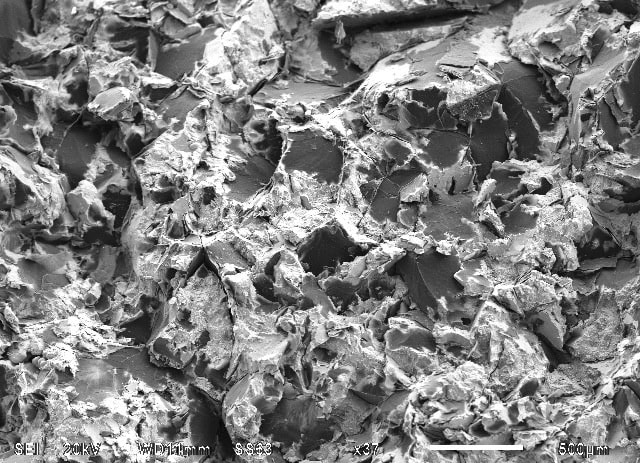
- SEM / Fractography: Using Scanning Electron Microscopy (SEM), we examine the fracture at high magnification to distinguish between failure modes such as fatigue, overload, brittle fracture, or stress corrosion cracking. We pair this with EDS when localized chemistry matters for defect identification.
- Mechanical / Chemical / Metallographic Verification: We confirm if the material met design specifications by testing hardness, tensile, metallography, and chemistry, and search for internal defects like porosity, inclusions, or improper heat treatment.
- Root Cause Reporting & Consultation: We don’t just send you a technical document; we give you a report that you can actually understand. We provide a detailed report with a clear and to-the-point conclusion of our investigation along with the documented objective evidence of our findings. Where possible, we provide recommendations to assist with practical next steps-process changes, material changes, verification plans, or additional testing to confirm the fix.
APL is equipped with all of the tools traditionally used in failure analysis, including SEM, optical microscopes, chemical analysis capabilities, and mechanical testing equipment, so all projects are completed fully in-house. This assures our customers that each failure analysis is done correctly and quickly, with all results and conclusions being verified for accuracy and reviewed by experienced metallurgists before being submitted to the client.
Sample Requirements To preserve critical evidence, failed parts should be handled carefully. If possible, avoid cleaning fracture surfaces or removing deposits prior to consultation. Contact us early-we’ll advise the best way to package and submit the sample.