Verify Your Materials Down to the Element.

Chemical composition is the foundation of a material’s performance. Two parts may look identical, but a small difference in carbon, sulfur, or trace elements can drastically alter strength, corrosion resistance, heat treat response, and weldability. Whether you are confirming a raw material shipment or reverse-engineering a competitor’s part, APL provides the analytical precision you need.
APL offers a full range of chemical testing services to verify grade, confirm certifications, identify unknown alloys, and detect subtle compositional variations that can drive defects or failure. We select the most effective and economical method based on your material, detection limits, and turnaround needs.
Why Chemistry Matters
- Confirm Compliance: Ensure materials meet the tight compositional tolerances of industry standards.
- Prevent Failures: Identify off-grade or mixed materials that could lead to premature failure or poor weldability.
- Solve Problems: Link mechanical issues to underlying compositional deviations or contamination.
- Control Quality: Strengthen quality documentation, PPAP support, and audit confidence.
Chemical Testing Capabilities
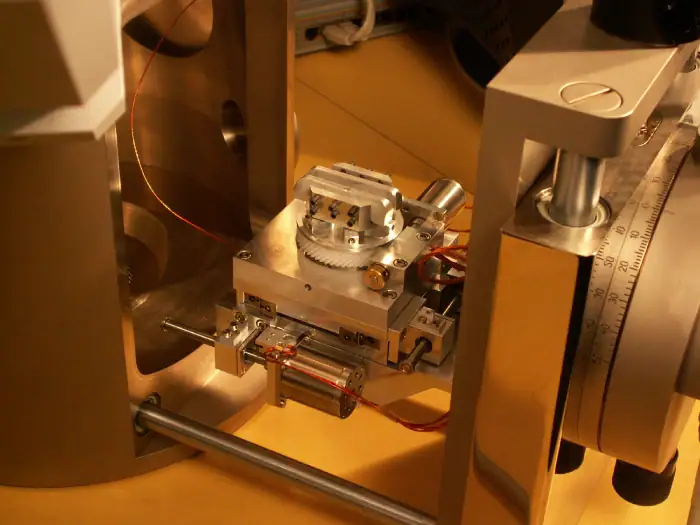
Optical Emission Spectroscopy (OES) When speed and accuracy are paramount, OES is the industry standard. It provides fast, multi-element analysis for many ferrous and nonferrous engineering alloys, including steels, stainless steels, aluminum, cast iron, copper alloys, nickel alloys, and zinc alloys.
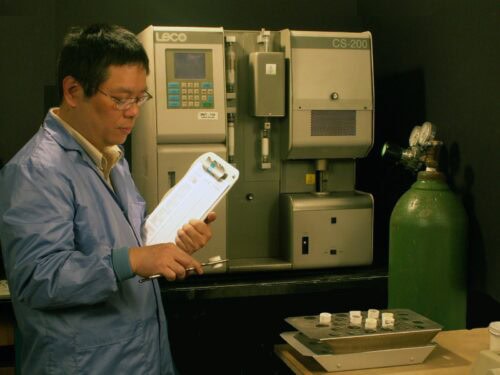
Combustion Analysis (C, S, N, O) Traditional spectroscopic techniques can sometimes struggle with light elements. We utilize LECO combustion analyzers to determine Carbon, Sulfur, Nitrogen, and Oxygen concentrations with an exceptionally high degree of accuracy-critical for quality control in steel and titanium.
SEM/EDS Analysis For microscopic chemical analysis, we employ Energy Dispersive Spectroscopy (EDS) via a Scanning Electron Microscope. This allows us to determine semi-quantitative elemental composition on a microscopic scale, which is essential for identifying inclusions, analyzing corrosion products, and characterizing small particles or defects.
XRF Analysis & Specialized Applications XRF supports material identification and specialized oxide/trace element analysis such as slag evaluations.
Material Identification / Grade Verification When traceability is uncertain-or mix-ups are suspected-APL can help confirm grade and identify unknown materials.
Sample Requirements Chemical analysis methods have specific sample form and preparation needs (solid, clean surface, minimum size, etc.). Contact us with what you have-we’ll recommend the best approach before you ship.